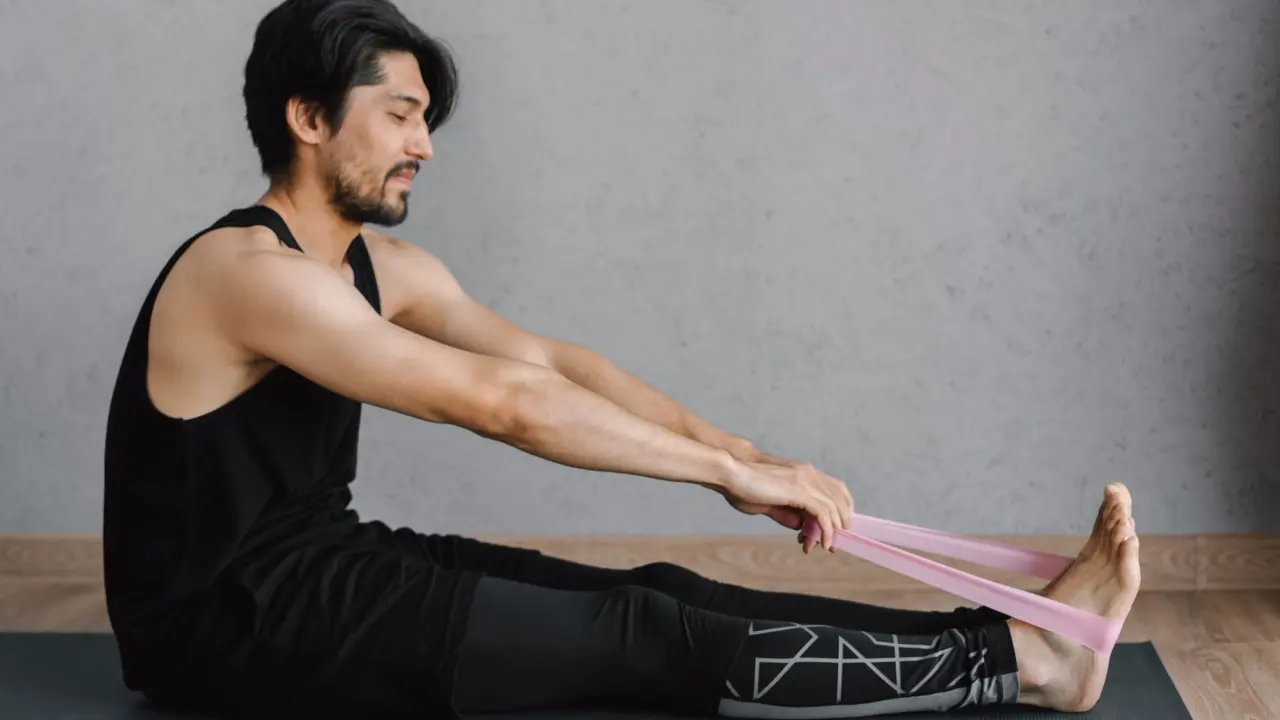
Say you open a box of bands and reach for the heaviest. For a resistance band workout plan, start with yellow or red, train two or three full-body days a week, and move up only when every rep stays clean.
The four-week program below suits anyone new to training, and it sits inside the wider topic of how to start working out. It uses bands for strength and pairs them with short mobility work.
Band training misconceptions that slow beginners down
Most stalled band programs share a handful of wrong assumptions: that bands are a toy, that a stronger band is always better, or that more days means faster results. Bands are a low-cost, joint-friendly way into strength training, and one cited review found similar bench press and squat strength gains compared with traditional equipment. The table sets each common belief against what the evidence supports.
| Common belief | What is supported | Planning use |
|---|---|---|
| Bands are too easy to build strength | One review found similar bench press and squat strength improvements to traditional equipment | Treat bands as a real training tool, not only a warm-up accessory |
| Start with the strongest band you can stretch | Beginners should start with yellow or red and level up once all reps are completed with good form | Choose the lighter band for the first sessions |
| More training days always means faster progress | Two or three full-body sessions give muscles time to recover and grow | Keep rest days between sessions |
| Warming up and cooling down are optional | A warm-up of 5–10 minutes should target major muscle groups, and a cool-down of 3–5 minutes of stretching follows each session | Budget these minutes inside every session |
Figures in the table come from a beginner band exercise guide and a full-body band workout guide.
Choosing bands and setting up
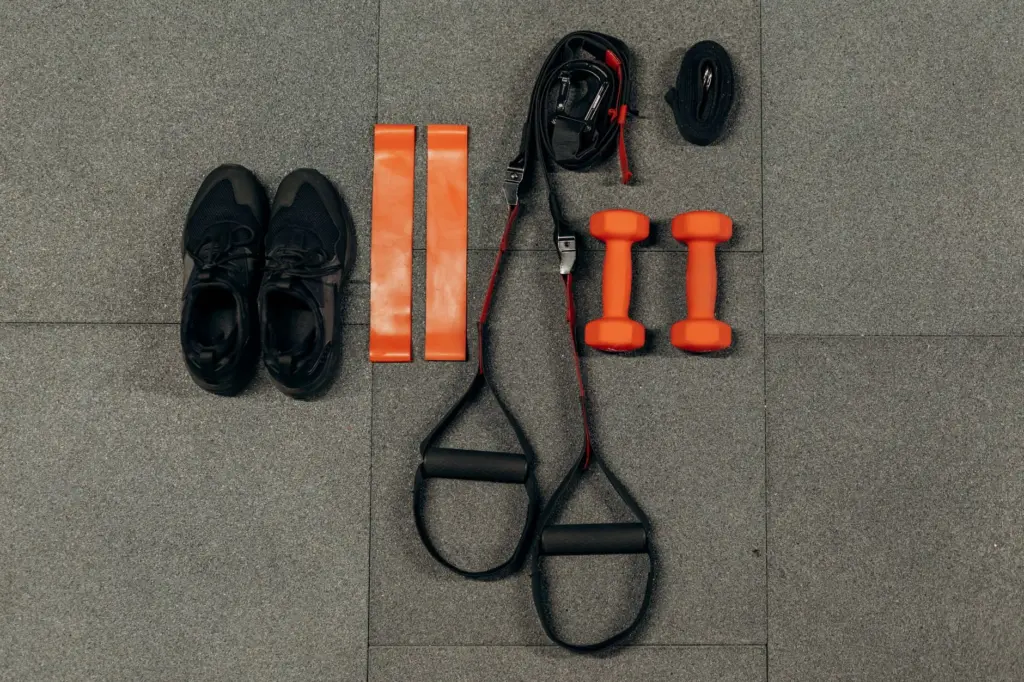
You do not need a large kit. One loop band, one tube band with handles and two or three resistance levels cover a beginner program, and starting light matters more than owning many bands. Beginners should start with lower resistance levels and master form before moving to heavier bands.
Band types and what they suit
- Loop bands: flat, continuous loops used for a variety of exercises, which makes them the natural choice for lower-body work in this plan.
- Tube bands with handles: usually used for upper-body exercises such as bicep curls and chest presses, so they carry the pressing and curling work.
- Therapy bands: flat and wide, often used in physical therapy and gentle stretching. They suit the mobility side more than the main strength sets.
Tension by colour
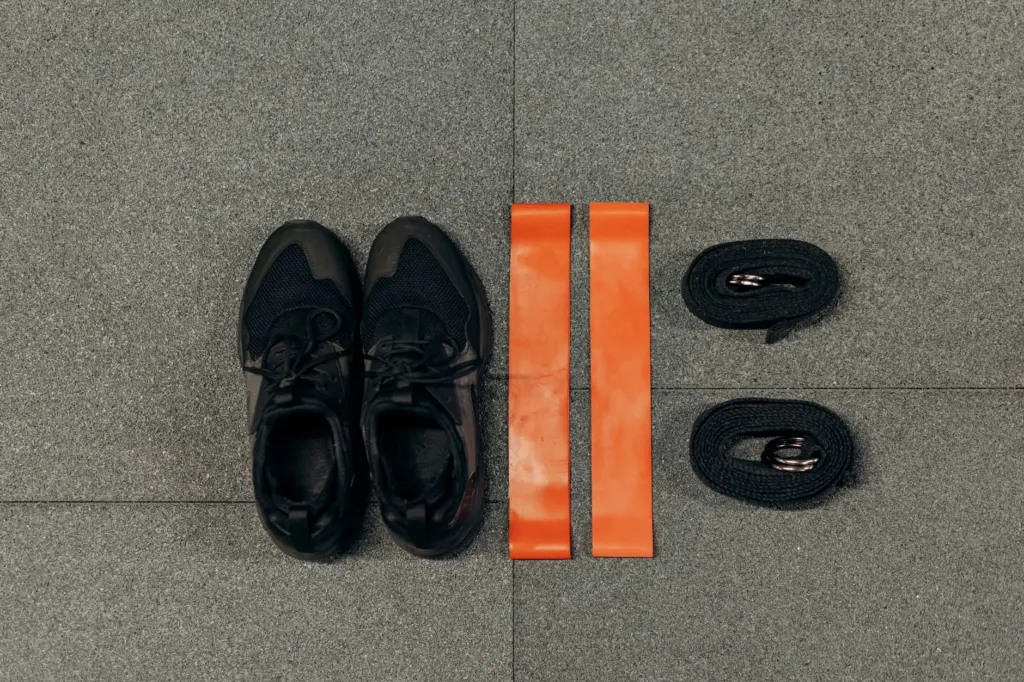
Colours are a quick shorthand for tension, but the values below are approximate and apply at 100% stretch. Brands differ, and bands come in various resistance levels so you can customise workouts. Check your own manufacturer’s chart before relying on a colour.
| Band colour | Approx. tension at 100% stretch | Planning use |
|---|---|---|
| Yellow | 3 lb / 1.4 kg | Starting band for brand-new trainees |
| Red | 4 lb / 1.8 kg | Alternative starting band |
| Green | 5 lb / 2.3 kg | First step up once reps are clean |
| Blue | 7 lb / 3.2 kg | Next step for upper-body pulls and presses |
| Black | 9 lb / 4.1 kg | Later progression for stronger muscle groups |
| Silver | 13 lb / 5.9 kg | Heavy option for continued progress |
| Gold | 18 lb / 8.2 kg | Top of this colour range |
Tension values are from a beginner band exercise guide.
To decide what to buy, pick the yellow or red end of the chart for the first four weeks and add the next colour only when the progression rule below says so.
The four-week weekly plan
The plan alternates two full-body sessions, Workout A and Workout B, on non-consecutive days, for example Monday, Wednesday and Friday. Each exercise gets 2–3 sets of 10–15 controlled reps, with 30–45 seconds of rest between sets.
| Week | Focus | What changes | Planning use |
|---|---|---|---|
| Week 1 | Form with a yellow or red band | 3 sets of 10–15 controlled reps | Stop each set while the last rep still looks like the first |
| Week 2 | Added volume | 4 sets on the same exercises | Same band; the extra set is the progression |
| Week 3 | Heavier band | Move to a thicker band once you reach 3 × 15 reps with solid form | Move up only on exercises where you hit the target |
| Week 4 | Tempo and supersets | Lowering phase slowed to 3 seconds; push-ups superset with band rows | Record results and compare with Week 1 |
The schedule and progression rules draw on a beginner band exercise guide, with the warm-up length from a full-body band workout guide.
Warm-up and cool-down for mobility
Mobility work frames every session. Spend 5–10 minutes on dynamic stretches such as leg swings, arm circles and torso twists to improve range of motion, and add cat-camel on hands and knees, arching and rounding the back slowly for 8 repetitions. After the last set, finish with 3–5 minutes of full-body stretching, as a beginner band guide suggests.
Workout A and Workout B
- Workout A: a band row, a chest press with a tube band and a loop-band lower-body movement such as a squat.
- Workout B: a biceps curl with a tube band, push-ups and a different loop-band lower-body movement, so legs are not trained the same way twice.
Pulling and pushing appear in both sessions, which keeps the shoulders balanced. If your shoulders need more attention, the Resistance Band Shoulder Workout: 20-Min Plan For Stronger, Pain‑Free Shoulders (2026) – Wholebodyreboot goes deeper on that area.
Progression and tracking
Progressive overload means gradually asking more of the muscle, and bands give you several ways to do it without buying a new colour every week. Use them in this order: add reps, then add a set, then move to a thicker band, then slow the movement.
Reps first, band second
Your cue to change bands is a performance target, not the calendar. Move to a thicker band once you hit 3 × 15 reps with solid form. If the form slips on the new band, return to the old one for a session and rebuild.
Tempo and supersets
Tempo is the speed of each rep. Slowing the lowering phase to 3 seconds adds muscle stimulus without a heavier band. In the final week, superset push-ups with band rows, which pairs a push with a pull for balanced shoulders; a superset means doing the two exercises back to back before resting.
Keeping a log
A simple notebook is enough. Write the date, the exercise, band colour, sets, reps and lowering time. The review point is every four weeks, when you track progress against your Week 1 entries.
If fat loss is your main goal, strength sessions work well alongside the walking routine in Walk Your Way Lean: The Simple 8-Week Plan To Burn Fat With Walking (No Gym Required) – Wholebodyreboot.
Frequently asked questions
| Question | Answer |
|---|---|
| How long should I rest between sets? | Rest 30–45 seconds between sets in this beginner plan. |
| Can I make a band harder without a thicker one? | Yes. Adjusting your stance or grip changes the resistance, so you can fine-tune difficulty between colours. |
| Do bands wear out? | Yes. Typical latex bands degrade with UV exposure and wear, so inspect them before every workout for cracks or thinning. |
| Will I outgrow light bands? | Heavier options exist. One brand’s range runs from ultra-light at 3 lb to ultra-heavy at 55 lb, so a set can grow with you. |