Short on time and gym access? A lower body resistance band workout can still build leg strength with one loop band and a mat, as long as the last reps feel harder than the first and form stays controlled.
If you are new to exercise in general, start with how to start working out and come back to this routine once the basics feel familiar. On non-band days, What Walking Does For Your Body: Evidence-Based Benefits, How Much You Need, And How To Start (2026 Guide) – Wholebodyreboot covers a lower-effort way to keep your legs moving. When bands start to feel too light, The Best Full-Body Dumbbell Workout: 3 Balanced Routines To Build Strength, Burn Fat, And Save Time (2026) – Wholebodyreboot is a natural next step.
Common myths about band leg training
Most doubts about bands come down to four assumptions: that they are too light, that form matters less, that they behave like weights, and that the stiffest band is the right place to begin. The table sets each against what the evidence supports.
| Misconception | What is supported | Planning use |
|---|---|---|
| Bands are too light to build leg strength | Band exercises can challenge muscles and support lower-body strength when the resistance is enough, form is good and the challenge rises gradually | Treat band choice as part of the training, not an afterthought |
| Bands are gentle, so form is optional | The last few repetitions should feel harder than the first few, without jerking or twisting | If you have to yank or twist to finish a rep, the band is too strong |
| Bands load joints like dumbbells or kettlebells | Bands add challenge without the same pressure on joints that external weights bring | A reasonable choice if heavy loading bothers your joints |
| Start with the strongest band you own | Begin at a resistance that lets you finish the full exercise with controlled form, then increase gradually | Earn the heavier band over time |
These points come from Scripps’s resistance-band leg guide and Montana State University Extension’s resistance-band program.
So can bands build leg strength?
Yes, with conditions. Scripps says band exercises support lower-body strength when you use enough resistance, keep good form and raise the challenge gradually. Each condition rules out a familiar failure:
- Too little resistance. A band you can stretch without effort gives your muscles little to work against, so strength gains stall.
- Too much resistance. A band that forces jerky or twisting reps swaps muscle work for momentum and sloppy positions.
- No progression. The same band for the same reps indefinitely stops being a challenge once you adapt.
The joint point is worth keeping in proportion. Montana State University Extension notes that bands do not put the same sort of pressure on your joints as external weights. That makes bands appealing, but it does not mean every movement is comfortable for every knee, which is covered in the knee section below.
Choosing a band without a gym
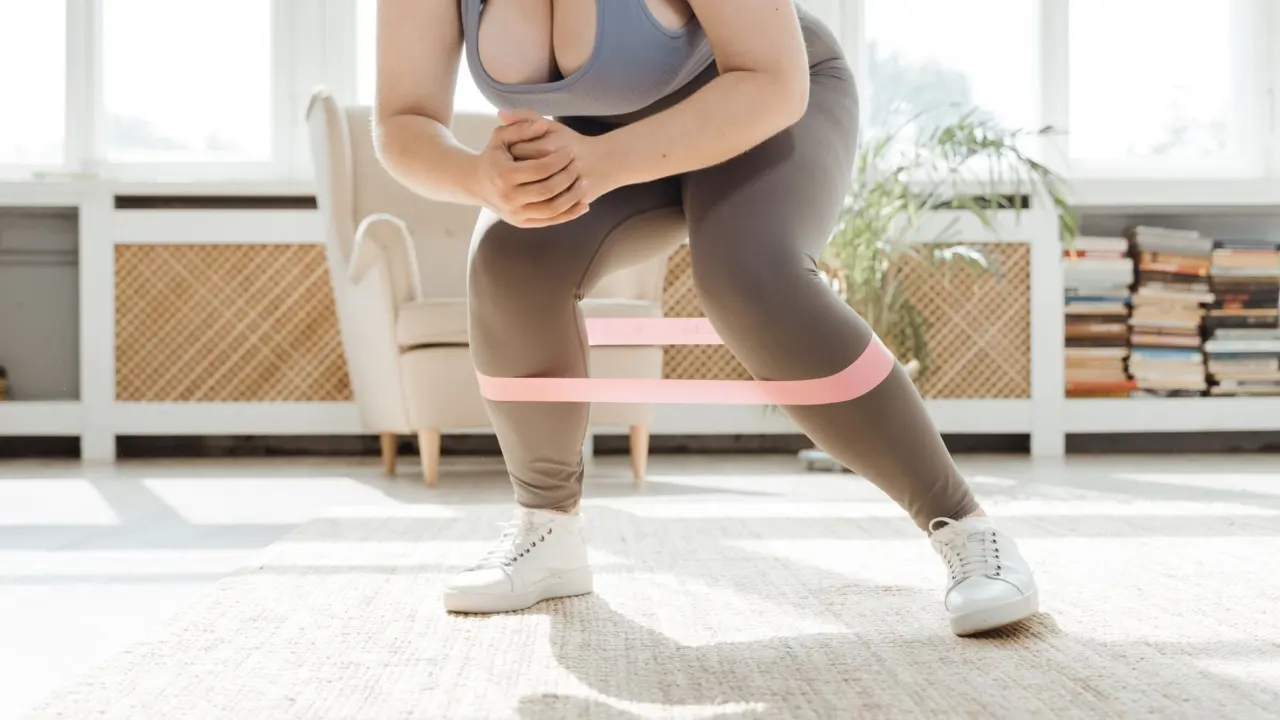
You do not need a gym or a rack of equipment. Prevention’s leg guide says all you need to get started is one medium to heavy loop band and a yoga mat. A certified trainer quoted there points out that bands travel anywhere and come in varying difficulty, so the same routine works in a living room, a hotel room or outdoors.
“Medium to heavy” is a starting suggestion, not a rule. Scripps advises beginners to pick the resistance that lets them complete the full exercise with controlled form. If a medium band allows that, use it. If your knees cave or your back arches to finish a rep, drop to a lighter band and rebuild.
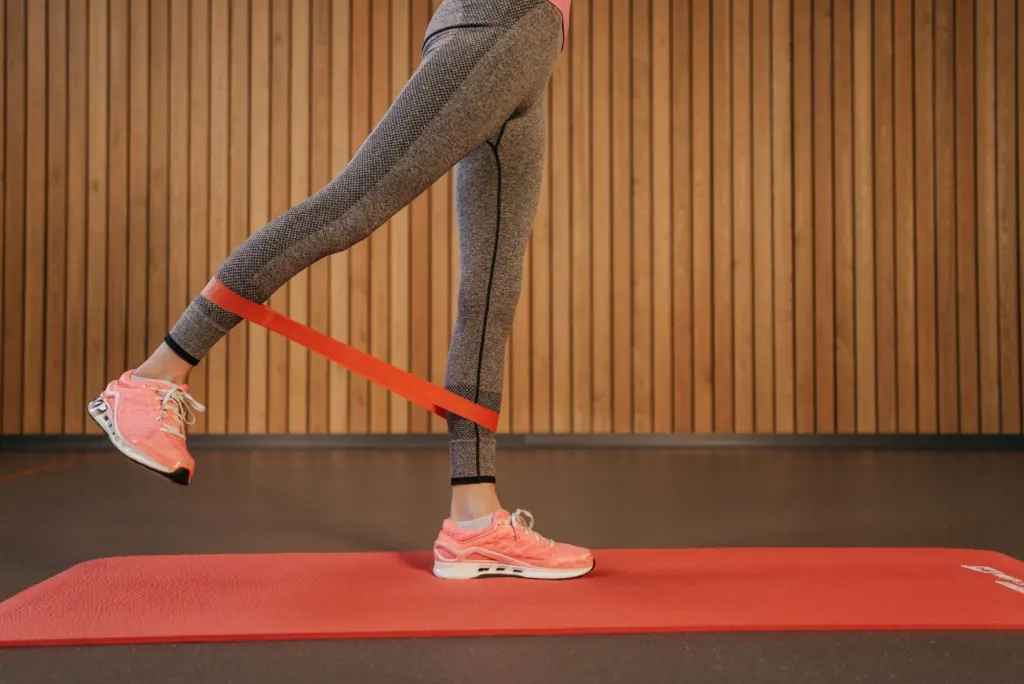
Use an effort check rather than a label. The last few reps of a set should feel more challenging than the first few. If every rep feels equally easy, the band is ready to go up a level. If the final reps fall apart, it is too strong for now.
The six-move routine
Warm up first. Scripps recommends giving your muscles a few minutes to get moving before adding resistance, such as easy marching, leg swings or bodyweight squats. For the working sets, Montana State University Extension’s program uses 2 sets of 12 reps per exercise, and that is a good default here. The ranges below come from other guides, so stay at the lower end of any range until the movement feels smooth.
Banded squat
Loop the band around both ankles and stand with your feet about shoulder-width apart, as Montana State University Extension describes it. During the squat, keep your weight in your heels. A band guide from a manufacturer suggests 3–4 sets of 10–12 reps and cautions that your knees should not travel past your toes. Treat the knee cue as a simple position check, and keep the set count at the lower end if you are new to the move. The band guide gives the full set of cues.
Forward lunge
Lower your hips until the front thigh is nearly parallel to the floor, according to that same guide, which gives 2–4 sets of 10–15 reps. Beginners can aim for the lower end of both ranges. Stop at a depth where you can still push back up without wobbling.
Lateral lunge
Montana State University Extension has you take a big step, about 2 feet, out to the side. Sit back into the stepping leg, then push back to the start. Use the 2 sets of 12 reps pattern from that program, then repeat on the other side.
Glute bridge
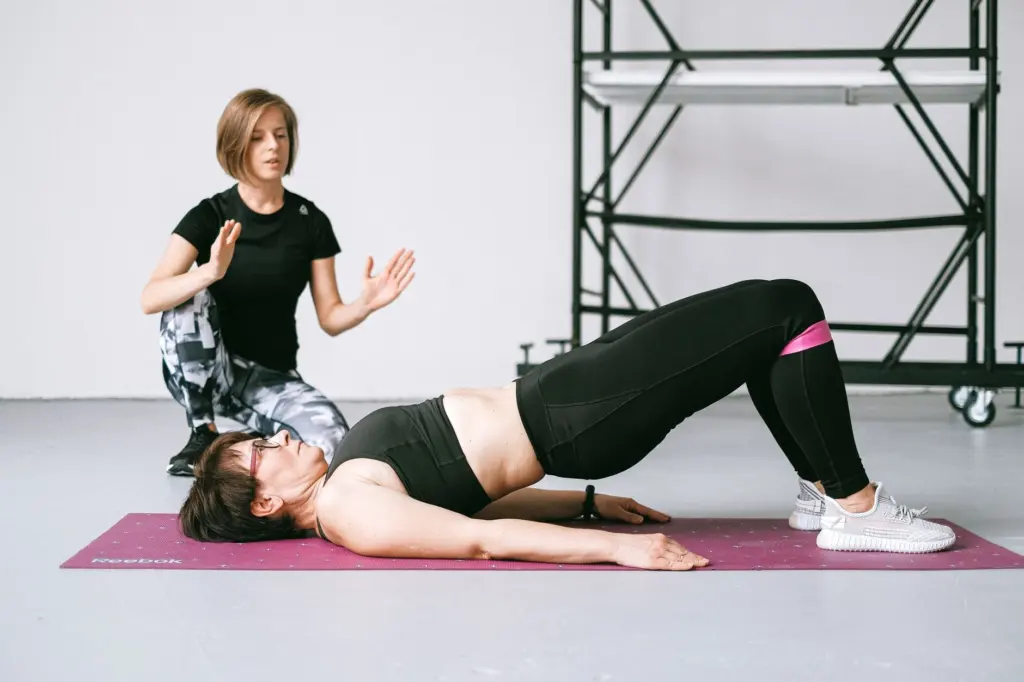
Lie on your back, loop the band around your thighs just above the knees, and push through your heels to lift your hips a few inches off the floor (Montana State University Extension). Scripps says to lift only as high as you comfortably can without excessively arching your lower back. Height is not the goal. A smaller lift with a squeezed finish beats a high arch.
Hamstring curl
Your hamstrings help bend your knee and contribute to many everyday lower-body movements, as Scripps puts it. The band guide above notes that a banded hamstring curl directly targets the hamstrings and core. Bend the knee against the band slowly instead of flicking it, and use 2 sets of 12 reps as your starting point.
Lateral leg raise
Montana State University Extension’s cue is to engage your core and squeeze your glutes as you lift your leg. Keep the lift controlled so the band, not momentum, supplies the effort. The same 2 sets of 12 reps per side works well here.
Progressing safely
Scripps recommends increasing the challenge gradually as you get stronger. Change one thing at a time, whether that is the band, the reps or a pause, so you can tell what is working and back off if form slips.
| Situation | Adjustment | Planning use |
|---|---|---|
| Form breaks down or the band is hard to control | Choose a resistance that lets you complete the full exercise with controlled form | Step down a band level before adding reps |
| First and last reps feel equally easy | The last few reps should feel more challenging than the first few | Increase resistance gradually, not in one jump |
| Glute bridge feels too easy | Increase resistance or pause for 2–3 seconds at the top of each rep | Try the pause first if you do not own a stronger band |
| Glute bridge feels too hard or awkward | Practice without the band first | Add the band once the movement pattern is smooth |
| Lower back arches during bridges | Lift only as high as you comfortably can | Shorten the range instead of forcing height |
All five rows come from Scripps’s resistance-band leg guide.
Knee-friendly changes
You can modify this routine for knee concerns, with one firm condition. Scripps advises talking with a healthcare provider before beginning a new workout if you are injured, recovering from surgery or have difficulty with balance. That step comes first, because the changes below adjust technique and do not replace medical advice.
- Drop the band to learn the pattern. Scripps suggests practicing without the band first, which lets you check position before adding tension.
- Keep weight in the heels. Montana State University Extension’s squat cue keeps the load toward the back of the foot, and one band guide adds that knees should not travel past the toes.
- Use a seated target for squats. Scripps lists a banded sit-to-stand at 8–12 reps for 1–3 sets, a squat-style option you can use in place of the banded squat.
- Prefer the bridge to deep lunges. Scripps’s glute bridge advice limits the range to what is comfortable, which makes it easy to scale to your own limits. Treat lunge depth the same way and stop short of the parallel-thigh position if it bothers you.
Whichever version you choose, a lighter band you can control beats a heavier one that pulls you out of position.
Frequently asked questions
| Question | Answer |
|---|---|
| How long should a session last? | It depends on the number of sets. Montana State University Extension’s 12-exercise program takes 40 minutes at 2 sets of 12 reps, or 20 minutes at 1 set each. A six-move version runs shorter at either set count (source). |
| How much rest do I need between sets? | Scripps lists about 30–60 seconds between sets for banded sit-to-stands, which is a reasonable guide for the other moves too (source). |
| Which muscles does the routine work most? | Hip-extension moves such as the bridge work primarily the glutes, according to Scripps. Hamstring curls target the hamstrings and core, and squats and lunges add the front of the thigh. |
| Is there a higher-rep glute option? | Prevention’s band guide gives a glute bridge pulse at 15–20 reps, a good finisher once the standard bridge feels easy (source). |