The best full body dumbbell workout gives results with simple moves and short sessions. It fits people who want strength, fat loss, and time efficiency. This guide lists three routines, shows equipment choices, and explains form. Each routine uses dumbbells and clear progressions. Readers learn how to train safely and make steady gains. Below you’ll find why these workouts work, how to set up, two complete routines (30-minute beginner and 45-minute intermediate), and practical technique cues so the sessions are effective and sustainable.
Key Takeaways
- The best full body dumbbell workout targets multiple muscle groups efficiently, making it ideal for strength building and fat loss with limited time.
- Using adjustable dumbbells and proper equipment like a bench and mirror enhances workout safety and performance by allowing correct form and progress tracking.
- A 30-minute beginner routine focuses on slow tempo and proper technique with key moves like goblet squats and dumbbell deadlifts for a strong foundation.
- The 45-minute intermediate circuit blends strength and conditioning through timed exercises such as dumbbell push presses and renegade rows to boost endurance and heart rate.
- Proper breathing, maintaining a neutral spine, and avoiding common form errors like knee collapsing are crucial for effective and safe full body dumbbell workouts.
- Gradually increasing weights while maintaining form ensures steady progress and injury prevention in your full body dumbbell workout plan.
Why Full-Body Dumbbell Workouts Work — Benefits And Who They’re Best For
Full-body dumbbell workouts hit many muscles each session, which raises overall metabolic demand and stimulates balanced strength gains across the body. Because each workout trains legs, posterior chain, pushing, pulling, and core, progress transfers well to everyday tasks and other sports. These sessions are time-efficient—two to four full-body workouts per week can deliver strength increases and body-composition improvements without daily gym visits.
They suit beginners learning movement patterns, busy adults who need efficient sessions, travelers with limited gear, and experienced trainees looking for focused, high-quality stimulus. Dumbbells force unilateral control and stability—this reduces side-to-side imbalances and improves joint health when programmed sensibly. They also allow precise load increments and easy progression: increase reps, sets, tempo challenge, or weight to keep the stimulus productive.
Who may need modifications: those with specific rehab needs, certain joint limitations, or athletes requiring sport-specific loading. For them, consult a qualified coach or clinician and use regressions (lighter load, fewer reps, simpler variations) until strength and mobility improve. Overall, the best full body dumbbell workout is one that matches your current ability, addresses your goals, and progresses gradually.
Equipment, Setup, And How To Choose The Right Dumbbell Weight
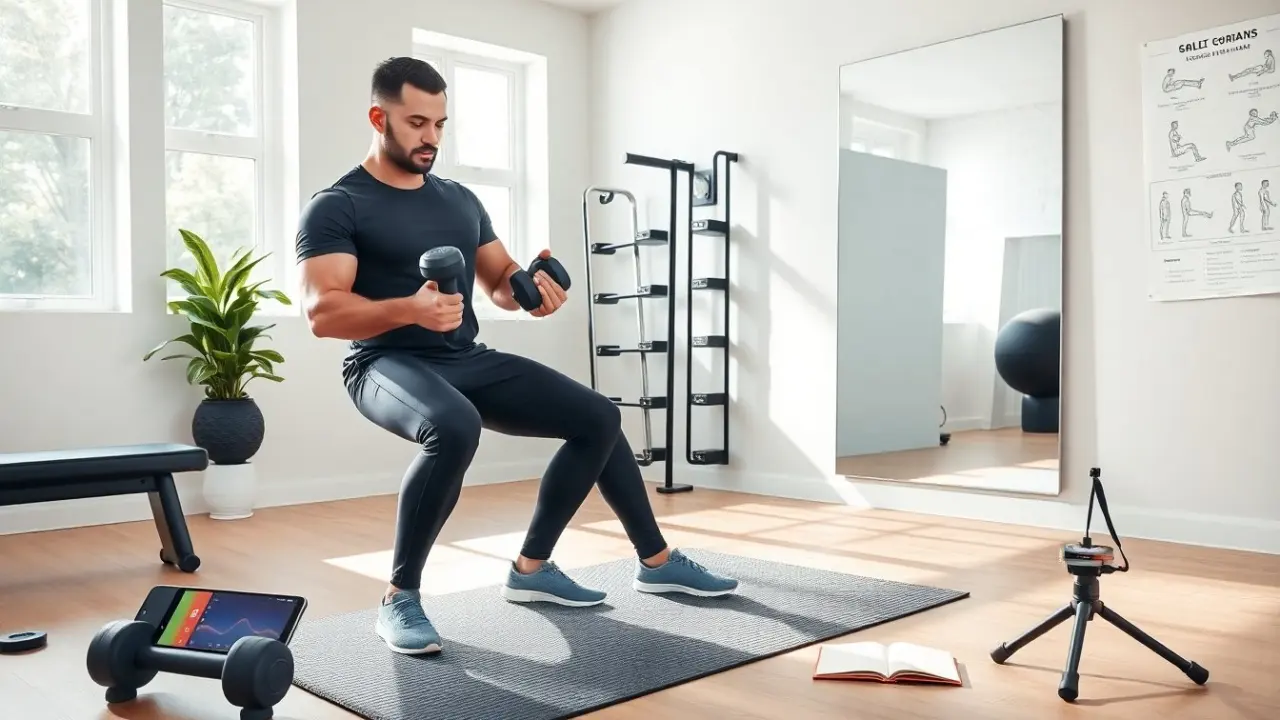
A pair of adjustable dumbbells covers most needs and saves space. If you have a limited set, prioritize a weight that challenges your lower body for 6–12 reps and another lighter pair for upper-body work. A flat or adjustable bench expands exercise options (incline press, Bulgarian split support), and a non-slip mat improves comfort for floor presses and plank variations. A mirror or phone for video feedback helps maintain form, especially for unilateral work.
Choosing weight: pick a load that allows you to complete target reps with good form while leaving 1–3 reps in reserve on strength-focused sets. For technique-focused tempo sets, choose a lighter load to control eccentrics. For conditioning circuits, dropdown weight so you can maintain movement quality for the entire interval rather than grinding to failure on the first round. Track weight, sets, and reps in a notebook or app so you can compare sessions and progress methodically.
Setup tips: clear a 6–8 ft workspace, keep a water bottle nearby, and warm up in the space you’ll train. Have a small towel and set your phone to airplane mode during high-focus intervals. Rest recommendations: 60–90 seconds between strength sets, 30–45 seconds in conditioning circuits, and 90–120 seconds after heavy compound sets if you need more recovery for quality repetitions. Prioritize safety—use collars on fixed dumbbells where applicable and avoid slipping hazards.
30-Minute Beginner Full-Body Dumbbell Workout (Strength + Form Focus)
This 30-minute session emphasizes slow tempo and form. Warm-up (5 minutes): joint circles, hip hinges with bodyweight, leg swings, shoulder band pull-aparts, and 1–2 sets of bodyweight squats and push-ups to prime the movement patterns. Focus on mobility in hips, thoracic spine, and shoulders before loading.
Workout: three rounds of five moves. Work through each exercise with controlled tempo (example: 2 seconds concentric, 3 seconds eccentric when possible) and rest between exercises as needed to stay technical.
- Move 1: Goblet squat — 3 sets of 8–10 reps. Cues: sit back, knees track toes, keep chest tall, inhale down, exhale up.
- Move 2: Dumbbell Romanian deadlift or dumbbell deadlift — 3 sets of 8–10 reps. Cues: hinge from hips, maintain neutral spine, feel stretch in hamstrings, keep weight close to legs.
- Move 3: Dumbbell bench press or floor press — 3 sets of 8–10 reps. Cues: scapulae supported, press in a controlled line, avoid flaring elbows excessively.
- Move 4: One-arm dumbbell row — 3 sets of 8–10 reps per side. Cues: brace core, pull elbow in back pocket, avoid torso rotation.
- Move 5: Plank with dumbbell drag — 3 sets of 30–45 seconds. Cues: keep hips level, move slowly and control breathing.
Progressions: increase reps to 12, add a fourth round, slow the eccentric, or increase weight when you can complete the top of the rep range with solid form for two consecutive workouts. Regressions: reduce range of motion, lower weight, or substitute assisted single-leg variations until balance and strength improve. Cool-down: 3–5 minutes of stretching focusing on hamstrings, quads, chest, and lats.
This best full body dumbbell workout for beginners teaches safe mechanics, builds a strength base, and establishes a habit of quality movement that you can scale over time.
45-Minute Intermediate Full-Body Circuit For Strength And Conditioning
This circuit mixes compound strength moves with conditioning elements to develop power, work capacity, and muscular endurance. Warm-up (6 minutes): dynamic mobility (leg swings, hip openers), 2–3 light sets of the first exercise pattern, and shoulder activation drills to prepare for pressing and rowing.
Circuit format: four rounds, 40 seconds on, 20 seconds off per exercise, with 90 seconds rest between rounds. Aim for high-quality reps on each 40-second interval. If technique breaks down, reduce weight or shorten the work interval.
- Exercise A: Dumbbell front squat — cue upright torso, elbows high, drive through heels.
- Exercise B: Dumbbell push press — use a small dip and leg drive to assist a strong overhead finish; breathe and brace through the core.
- Exercise C: Renegade row — maintain a tight plank, row with control, and limit hip rotation.
- Exercise D: Bulgarian split squat — focus on knee tracking and balance; hold a weight in the goblet or racked position to vary demand.
- Exercise E: Dumbbell swing or single-arm clean — choose the less technical option if high fatigue arises; prioritize hip drive and neutral spine.
After the four rounds, add a 5-minute core finisher: alternating bicycles for 45 seconds with 15 seconds rest, then side plank hold 30–45 seconds per side for 2 rounds, or an equivalent that challenges stability without compromising spinal position. Scaling: beginners can use 30/30 work/rest or reduce rounds to three. Advanced trainees can extend to 50/10, add a heavy anchor set (e.g., 3–5 heavy goblet squats between rounds), or increase rounds to five for added volume.
This best full body dumbbell workout raises heart rate and increases muscular endurance while preserving strength focus, and it is easy to adapt to different training levels by adjusting intervals, weight, or rounds.
Technique, Breathing, And Common Form Mistakes To Avoid
Breathe out on the effort (concentric) and breathe in on the return (eccentric) for most lifts; for heavy multi-joint moves, use a braced breath (diaphragmatic) to protect the spine. Keep a neutral spine on all lifts—imagine a straight line from the head through the tailbone. Engage the lats to protect the lower back during deadlifts and rows, and think “chest up” on squats and presses to maintain posture.
Common mistakes and quick fixes:
- Rounding the back during deadlifts/rows — fix by reducing load, pausing at the top of the hinge to learn position, and cueing chest up and shoulders back.
- Knees collapsing on squats — fix with lighter load, conscious cue to push knees out, and add glute activation drills (band walks, clams) to improve hip control.
- Excessive elbow flare on presses — keep elbows at roughly a 45-degree angle to the torso to protect shoulders.
- Using momentum on single-arm moves — slow the eccentric and use a lighter weight to maintain control; film sets to self-correct.
Use progressively challenging but manageable weights, and prioritize quality reps over arbitrary load increases. If you experience sharp joint pain, stop and reassess mechanics or consult a professional. Recording a short video for self-review or working with a coach for a few sessions speeds up learning and reduces the risk of bad habits. The best full body dumbbell workout gives gains only when the trainee moves well—so invest time in technique and the returns will follow.