A quick morning stretch routine fits into 10 minutes with only a mat or your bed: start with easy lying moves, work through the spine, neck and hips, and stop at moderate discomfort or sharp joint pain.
Doing a few moves well, in the same order each day, matters more than the number of stretches. Beginners who want the wider picture can read about how to start working out, and the sequence below is built to work in a small bedroom with no equipment.
Why the body feels stiff after sleep
The body can be stiff after a night of sleeping, as Prevention notes. Two overnight conditions help explain it. Hinge Health points out that your joints get little movement while you sleep, and that most of your muscles stay in a fixed position during REM sleep. Neither is harmful, but both leave you less ready to bend, reach or turn the moment you get up.
Early movement addresses both. Peloton describes it as lubricating the joints through synovial fluid, priming the muscles and improving blood flow to joints and muscles. It adds that this can boost your energy. That is a described effect rather than a measured amount, so treat extra energy as a likely bonus, not a promise.
This mechanism sets the order of the routine. Wake the joints with small, easy movements first, then ask the spine, neck and hips for more range. Mobility, in this sense, is simply how comfortably your joints move through their usual range once the night’s stillness has worn off.
Choosing the length of a morning stretch
A 10-minute routine is a sound default. SheKnows presents a 10-minute stretching routine as a morning option, and the only equipment it lists is a yoga mat or your bed. That makes the length realistic for most mornings, even in a small space.
On rushed days, shorten the list rather than the quality. An expert quoted by Prevention advises doing a few stretches really well and consistently, which beats hurrying through many. Choose the moves that bother you most when you wake, whether that is a stiff lower back, neck or hips, and keep the rest for days with more time.
Hold times in the sequence below are guides, not targets. Some moves are held for 10-15 seconds per side and others for 20 seconds, while cat-cow is counted in cycles. Hold only as long as you can breathe steadily.
The 10-minute sequence, in order
Hinge Health suggests doing its first five moves before you even get out of bed and the remaining five standing. This routine borrows that logic: lying moves first, hands-and-knees work next, standing moves last. The table gives the timed moves in a sensible order, and the notes beneath it cover the rest.
| Order | Move | Timing | Planning use |
|---|---|---|---|
| 1 | Starfish stretch | 1 minute | Opens the whole body while you are still lying down, so it works on a bed or mat. |
| 2 | Lumbar trunk rotation | Hold 10-15 seconds per side | A lying twist for the lower back; switch sides after each hold. |
| 3 | Single knee-to-chest | Hold 20 seconds, repeated three times on each side | A slow held stretch you can do lying down; finish all repeats before moving on. |
| 4 | Cat-cow | 10-15 cycles | A moving spine exercise on hands and knees; count cycles instead of watching the clock. |
Timings come from SheKnows’ 10-minute routine and Prevention’s morning stretch routine.
In bed or on the mat
Begin with the starfish stretch: lie on your back and reach your arms and legs out wide for 1 minute. It asks very little of cold joints, so it doubles as the warm-up. Move into the trunk rotation next, letting your knees drop toward one side while your shoulders stay settled, then hold for 10-15 seconds and switch sides. Keep the twist small and comfortable.
Knee-to-chest comes last in the lying block. Hold each knee for 20 seconds, and repeat three times on each side. If one side is clearly tighter, do not force it to match the other. Aim for an even, steady feeling.
Spine mobility with cat-cow
Cat-cow is the main spine move. Prevention says it improves spinal mobility and helps release tension in the neck, back and abdomen, and it calls for 10-15 cycles. Move slowly between rounding and arching, and let your breathing set the pace so the movement stays smooth rather than rushed.
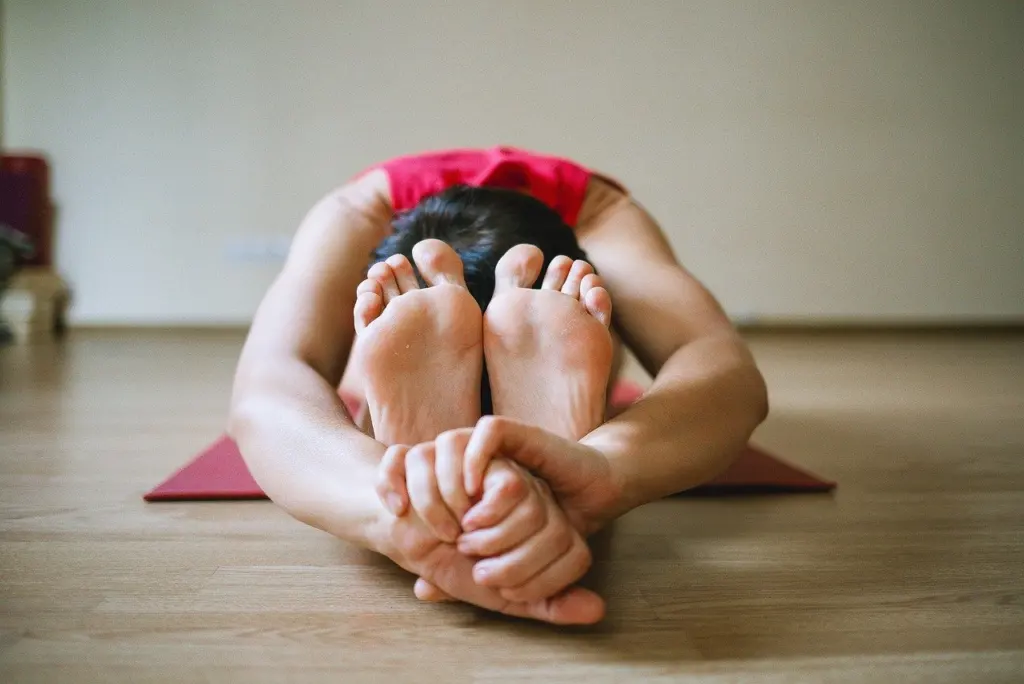
A consistent routine is also linked with healthy posture, according to Hinge Health, which is one reason to spend this block on the spine and not skip to the standing moves.
Neck release
Cat-cow already loosens the neck, so a neck side stretch works best straight after it. Sit or stand tall with your shoulders relaxed, then ease one ear toward the same shoulder and breathe. Stop as soon as you feel a gentle pull, and never push into a pinch. Change sides and keep the movement small. If your neck feels irritated, make the range smaller instead of holding longer.

Hips and the standing finish
Stand for the last block. Peloton’s hip circles continue at a steady pace, then repeat in the opposite direction. Keep the circles wide enough to feel the hips move but small enough that you stay balanced. Stand beside a wall or bed if you feel unsteady.
If the timer reaches 10 minutes before you finish, stop there. Next time, drop the move you like least rather than shortening every hold.
Warm-up and safety limits
Stretching in the morning is generally safe when you ease into it. Prevention advises easing into stretches, especially first thing in the morning, and trying some gentle movement or light activity before you start. A short stroll around the room or the lying moves above can serve as that warm-up.
The same source gives a clear stopping rule: back off if the stretch feels like moderate or high-level discomfort, or if you feel any sharp joint pain. Mild tension is the working range; sharp joint pain means stop. Ask a clinician if the same movement keeps hurting, and in the meantime do the moves that remain comfortable.
Putting the stiff-after-sleep mechanism together with those limits gives a simple rule: stay gentle at the start, add range only as the body loosens, and stay inside the comfortable range.
Making the routine stick
A repeatable routine beats an ambitious one. SheKnows describes regular stretching as increasing flexibility, improving circulation and posture, and relieving stress, while Hinge Health ties a consistent morning routine to healthy posture. These are stated benefits, not measured results, so judge success by how easily you move when you get up.
Keep the order fixed so the sequence becomes automatic. Once it feels easy, add strength work with the Bodyweight Workout Routine: Build Strength Anywhere In 8 Weeks – Wholebodyreboot, which suits the same small-space setup. If you prefer to follow a printed plan on the wall, the Full-Body Stretching Routine PDF: A Simple 10-Min Daily Plan To Boost Flexibility And Reduce Pain (Printable) – Wholebodyreboot covers a similar daily plan.
Frequently asked questions
Do I need equipment or a lot of space?
No. The 10-minute routine needs only a yoga mat or your bed. A foam roller is optional; Peloton describes a foam roller chest expansion held for 1-2 minutes, but it is not part of this sequence.
Should I drink water before stretching?
It helps. Prevention notes that staying well hydrated allows your muscles and tendons to be more pliable, so a glass of water before you start is a reasonable habit.
Do morning stretches really boost energy?
They are described as doing so, because early movement improves blood flow to joints and muscles. No amount is given, so expect to feel looser and more awake rather than a fixed jump in energy.
Why do my calves feel tight when I wake up?
Hinge Health says your toes are usually pointed during sleep, which shortens the calf muscles over the course of the night. A gentle calf stretch after your first few moves is a sensible addition.